Meta Description:
Choosing the right tech stack is critical for startups. Learn how to select frontend, backend, database, and cloud technologies for scalability, performance, and long-term success.
Featured Image Suggestion:
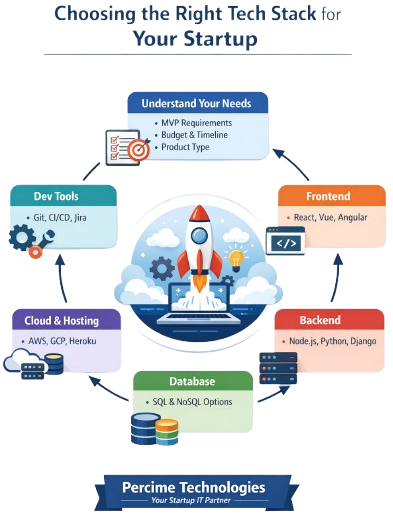
Tech stack infographic showing layers: Frontend → Backend → Database → Cloud → Tools
Introduction
Choosing the right tech stack isn’t just a technical decision—it’s a strategic one. The technologies you choose today will define your startup’s scalability, maintainability, and speed-to-market.
At Percime Technologies, we guide startups to build robust, scalable, and future-proof solutions. In this guide, we’ll show you how to select the best tech stack for your startup, ensuring your product is built on solid ground.
Image Suggestion: Founder working on a laptop / coding scene
Key Takeaways
-
Align Tech with Business Goals
-
Consider All Layers: Frontend, Backend, Database, Server, DevOps Tools
-
Prioritize Scalability & Performance
-
Evaluate Developer Expertise & Community Support
-
Factor in Budget & Time-to-Market
-
Future-Proof Your Stack
Why Your Tech Stack Matters
Your tech stack is the invisible architecture underlying your product. It affects development speed, maintenance, security, and user experience.
Startups with the right tech stack can scale faster, pivot easily, and attract investors.
Image Suggestion: Tech architecture infographic (layered stack)
Core Components of a Digital Foundation
A typical tech stack includes several layers, each critical to your product:
Frontend (Client-Side)
-
Purpose: What users see and interact with
-
Popular Choices: React, Angular, Vue.js
Backend (Server-Side)
-
Purpose: Handles data processing, business logic, and database interaction
-
Popular Choices: Node.js, Python (Django/Flask), Ruby on Rails, Java (Spring)
Database
-
SQL (Relational): PostgreSQL, MySQL – structured, reliable, ACID compliant
-
NoSQL (Non-relational): MongoDB, Cassandra – flexible, horizontally scalable
Cloud & Hosting
-
AWS(Amazon Web Services), Google Cloud Platform, Microsoft Azure
-
Containerization: Docker, Kubernetes for deployment and orchestration
DevOps & Tools
-
Git (version control)
-
CI/CD pipelines: Jenkins, GitHub Actions
-
Project management: Jira, Trello, Notion
Aligning Tech with Business Goals
Before picking a tech stack, define your startup’s objectives:
-
Speed-to-Market: Ruby on Rails or Laravel for MVPs
-
High Performance & Scalability: Node.js, Java, Python
-
Specific Functionality: Python for AI/ML, Node.js for real-time apps
-
Long-term Maintainability: Established frameworks with strong communities
Pro Tip: Let the business problem drive the technology choice, not the other way around.
Scalability & Performance
-
Vertical vs. Horizontal Scaling – Plan for growth
-
Microservices Architecture – Break large apps into smaller, manageable services
-
Database Optimization – Choose SQL/NoSQL based on expected traffic
-
Caching & CDNs – Reduce server load and improve content delivery
Image Suggestion: Scalable cloud architecture diagram
Developer Expertise & Community Support
Even the best tech stack requires skilled developers:
-
Talent Availability: Python, Node.js, and JavaScript have large talent pools
-
Community Support: Active communities reduce friction and accelerate learning
-
Existing Team Skills: Leverage your team’s expertise to save time
-
Documentation: Well-documented tools reduce implementation errors
Budget & Time-to-Market Considerations
-
Open-source options can reduce licensing costs
-
Cloud hosting choices (serverless vs dedicated) impact cost and maintenance
-
The framework learning curve affects development speed
SQL vs. NoSQL Databases
| Feature | SQL | NoSQL |
|---|---|---|
| Data Model | Structured | Flexible |
| Scalability | Vertical | Horizontal |
| Query Language | SQL | Varies |
| Use Cases | Transactions, e-commerce | Real-time apps, big data |
| ACID Compliance | Yes | Often BASE |
| Complexity | Schema upfront | Easy start, complex scaling |
Future-Proofing Your Stack
-
Choose technologies with active development and a future roadmap
-
Favor modularity and interoperability (REST, GraphQL)
-
Avoid vendor lock-in
-
Design for easy updates or migration
Image Suggestion: Agile/modular architecture diagram
Putting It All Together
Choosing the right tech stack is strategic, not just technical. Consider:
-
Business goals
-
Team capabilities
-
Budget & timeline
-
Scalability and future growth
At Percime Technologies, we help startups build scalable, maintainable, and future-ready products.
Image Suggestion: Circular infographic summarizing the tech stack layers
Call to Action
-
Explore our projects: Percime Technologies
-
Get expert guidance: Contact Percime Technologies